Google Search Generative Experience: What It Means for Organic Traffic
Just before the news outlets announced it, Google Search Generative Experience had already begun displaying in my analytics reports. One of the very early mornings last year, I was reviewing Search Console for a client site when I came across a very odd situation: the click-through rate of our best-performing page had fallen by almost a third, apparently on its own. There was nothing suspicious from our side. It was not the case of a Google penalty nor the case of an unusual algorithm update getting detected. But there were just fewer clicks even for the same rankings.
Google had, of course, launched an AI-generated summary for that specific search query, and that was why people were getting answers from the results page right away instead of visiting the website. That moment of realization for me about AI Overviews (SGE to be exact) honestly changed how I think about SEO work daily.
If your company has a blog, a small business website, or you are simply in the position where they point a finger towards you when their traffic gets cut down, you would do best not only to be familiar with the terminology but also the part about “what really happens to your stats”.
So what is Google Search Generative Experience, really
If you strip away all the technical terms, it boils down to something quite simple: Google has started to use AI to generate written answers and is placing them at the very top of the results page, before the traditional list of “ten blue links”. The system pulls information from several different sources, blends them into a single summary, and sometimes cites only two or three of them via small links. In Google’s words, the aim is to make it easier for people to get an answer more quickly.
Unfortunately, for individuals who rely mainly on search traffic, they are missing out completely on a large group of those visitors who will not scroll all the way back down because they already found the answers in the summary. Why would they scroll again? As far as I can see, this is what happened to several of the client websites we follow, and the results are not the same in all cases (the differences are quite considerable, actually). It depends largely on the subject you deal with, and the kind of content that you present, and – in all honesty – quite a bit of luck about which searches get this AI-powered Summary section first.
Who actually gets hurt (and who doesn’t)
This is what I’ve become used to seeing after keeping a record of it for some time.
Definition and “what is” type of content gets the worst of it. If you’ve written an article just to answer “what is compound interest, ” or “how many ounces in a cup, ” the Overview can just answer that. No reason for the click.
I had a recipes conversion page lose nearly 40% of its traffic in two months, after an Overview appeared in the results to answer its core questions.
Comparison and “best of” content is more persistent, but not invulnerable. Users still want to see the image of the actual product, the comparison tables, the actual reviews. AI cuts are okay at providing a cursory answer, but they are terrible at niceties, and those are increasingly what users want. My “best budget laptops” piece hardly moved. It is the stuff that ‘demands be trusted, expert or a personable story’ that stands up to scrutiny.
Medical advice, money advice, anything YMYL (Your Money or Your Life). Google is a little more careful here, and the users of Google are too. The question is not ‘what is being said?’ but ‘who is saying it?
If you are familiar with ranking drop scenarios, it seems familiar to all those who have already experienced such changes. This is the same sort of sudden overnight shift that we explained in the guide on core update recovery at Google. Although the trigger is different, the overall principle remains the same: those pages that have been created with poor and very narrow content can be the ones that experience these first.
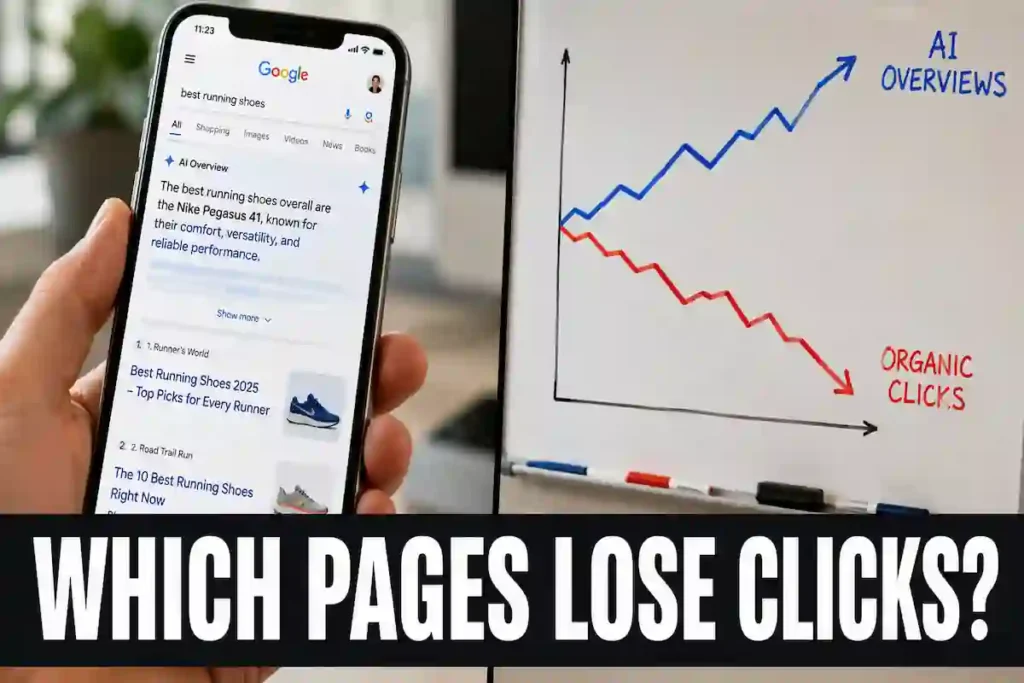
Most of the transactional and local queries remain untouched. For example, if someone is looking for ‘ plumber near me’ or ‘ buy Nike Air Max 90’, they still need to click through to buy or book something.
If AI can’t execute that action, then the query may be fulfilled by AI but would still need to be taken to the action point. What I actually did with my SEO focused content strategy.
I won’t lie and claim to be building the perfect solution. Nobody has yet, since the landscape is constantly changing every few months, but what has worked so far with the traffic I have received and based on no theory, just real data: I stopped writing page upon page just for answering 1 tiny question. For questions that only need a sentence or two, I no longer create a whole page.
I glue that quick answer onto something larger, more valuable, a guide list of tips and tricks with heft an AI abstract can’t get through the filter (ex: “How to repair a leaky tap” isn’t a brief thin page, but an actually-useful troubleshoot guide with photos). I relied more on original data and lived experience.
AI Overviews are composed of content that’s already there. They can’t reference an opinion you haven’t published yet, and they can’t reference a personal outcome. Once I began dropping in real screen captures, real before and after figures, real dates and locations, those pages maintained their click-throughs. Really better than the general pages on the same topics.
I began to optimize the time for citations, instead of only prioritizing the ranking of the citation.
Every time I have seen an “AI Overview,” it again at least links out to 2-3 sources. Even if you are not getting clickthroughs there, you are still getting your name out there, building brand awareness, and sometimes, if you have established your name as credible, people will click through anyway.
I have now begun to consider “is this page cited in the overview” as a key metric to check manually apart from position.
What I actually changed in my content strategy
This is what I’ve become used to seeing after keeping a record of it for some time. Definition and “what is” type of content gets the worst of it. If you’ve written an article just to answer “what is compound interest, ” or “how many ounces in a cup, ” the Overview can just answer that. No reason for the click.
I stopped writing pages that only answer one small question
I had a recipes conversion page lose nearly 40% of its traffic in two months, after an Overview appeared in the results to answer its core questions. Comparison and “best of” content is more persistent, but not invulnerable. Users still want to see the image of the actual product, the comparison tables, the actual reviews.
I leaned harder into original data and first-hand experience
AI cuts are okay at providing a cursory answer, but they are terrible at niceties, and those are increasingly what users want. My “best budget laptops” piece hardly moved. It is the stuff that ‘demands be trusted, expert or a personable story’ that stands up to scrutiny.
I started optimizing for the citation, not just the ranking
Medical advice, money advice, anything YMYL (Your Money or Your Life). Google is a little more careful here, and the users of Google are too. The question is not ‘what is being said?’ but ‘who is saying it?
Most of the transactional and local queries remain untouched. For example, if someone is looking for ‘ plumber near me’ or ‘ buy Nike Air Max 90’, they still need to click through to buy or book something.
If AI can’t execute that action, then the query may be fulfilled by AI but would still need to be taken to the action point. What I actually did with my SEO focused content strategy.
I diversified traffic sources instead of fighting Google.
I won’t lie and claim to be building the perfect solution, nobody has yet since the landscape is constantly changing every few months, butwhat has worked so far with the traffic I have received and based on no theory just real data: I stopped writing page upon page just for answering 1 tiny question For questions that only need a sentence or two I no longer create a whole page.
I glue that quick answer onto something larger, more valuable: a guide list of tips and tricks with heft; an AI abstract can’t get through the filter (ex: “How to repair a leaky tap” isn’t a brief thin page, but an actually-useful troubleshoot guide with photos.) I relied more on original data and lived experience.
AI Overviews are composed of content that’s already there.
They can’t reference an opinion you haven’t published yet, and they can’t reference a personal outcome. Once I began dropping in real screen captures, real before-and-after figures, real dates and locations, those pages maintained their click-throughs. Really better than the general pages on the same topics.
I began to optimize the time for citations, instead of only prioritizing the ranking of the citation.
Every time I have seen an “AI Overview,” it again at least links out to 2-3 sources. Even if you are not getting clickthroughs there, you are still getting your name out there, building brand awareness, and sometimes, if you have established your name as credible, people will click through anyway.
I have now begun to consider “is this page cited in the overview” as a key metric to check manually apart from position.
I focused on expanding different traffic sources.
I am more inclined to talk about what actually brought the visitors to my websites rather than how we managed to increase Google rankings. In fact, quite a number of the sites I handle today receive a lot of traffic from newsletters, YouTube, and even Pinterest – the platforms that don’t rely on what’s on Google’s homepage. Of course, it can’t altogether replace organic search since it’s still a bit different, but at the same time, it gives you a feeling of security.
Pretty much this is an extension of a wider concept we use for every client site – the six fundamentals we have defined in our SEO services, just adjusted to an altogether new issue. AI Overviews did not alter the basics or underlying concepts; they only intensified the standards for content quality that are considered “good enough”.
Mistakes I made early on
I will be honest and tell you a few things that did not go so well.
First off, I was just trying to “write for AI” with a long list of FAQ schemas and short, robotic-looking answer paragraphs, assuming that Google would pull the exact phrasing from my website to the Overview. To my surprise, it barely worked out, and frankly my pages were reading much worse for real humans. Just optimizing a page for a summary at the expense of making it more or less human-readable is a wrong move that will not deliver.
Also, I was overly nervous at the beginning; I was so sure that SEO was on its way out. But it is not; overall, the organic search traffic of the majority of clients was not only not declining, but it also remained mostly stable. Still, when it comes to redistribution, some lost while certain types of pages (In particular the ones at a lower depth, but very helpful) actually gained. Seems like, now more than ever, Google rewards with extra visibility genuine in-depth content instead, that is.
A few things worth checking on your own site
Look at Search Console’s “Overview” for your best-performing search queries and see which have resulted in an AI Overview.
Don’t compare your ranking alone for these keywords; instead, look at the changes in the CTR for those keywords over time. Rankings might remain the same with no change in appearance, yet clicks may be steadily declining.
Pinpoint the pages on your site that are just “quick answer” kinds of pages versus those that offer substantive resources that will genuinely benefit your users.
Ensure that your brand or domain is listed as a source on the article if an AI Summary appears for your major keywords.
There’s no need to invest in costly tools for doing this analysis. Search Console, together with some time spent by you, will help you uncover almost all of the knowledge you want.
Google itself seems to be pretty transparent about the purpose here; the company’s documentation on AI features in Search describes this as making it easier for people to begin their research instead of relying solely on site visits. If you want a clearer version of Google’s intentions, you should read their statement themselves rather than rely on secondhand analysis like this one.
FAQs
Is the advent of Google SGE a death knell for SEO?
Absolutely not. Google SGE is just a means to change the type of pages that get clicked. It hasn’t totally removed organic search traffic.
Which types of content are most affected by AI Overviews?
The main problem caused by AI Overviews that page creators must pay attention to is that those short, definitional, or single-fact style pages are the ones getting most affected and losing the largest number of clicks. Conversely, longer-form guides and comparisons with personal-experience type content usually continue to fare well.
Is there a way to prevent my website from being shown in the AI Overviews?
Limited control has been made available by Google to users in certain areas, but there seems to be no single, simple way to completely disqualify a site while still participating in classic search results ranking.
Shall I modify how I write for AI Overviews Mainly?
The best approach would be to keep your content targeted mainly and purely at humans and be clear and helpful with it. Attempting to artificially optimize for an AI Summary will probably result in your content becoming weaker, even without a sure return.