2026 Helpful Content Update: What Do Website Owners Need to Know Before Traffic Drops
One Monday morning, I was monitoring rankings for a small business site. I was working on it, and I saw the article we had circulated word on had that before been mysteriously dropped onto page two.
It happened suddenly, over a few days.
The Web master thought it was simply the latest ranking cycle. He was wrong. It was a wake-up call that Google’s methods of ranking have become more sophisticated for showing off content that is truly useful, and demoting content that is simply optimized.
In this article, we will discuss the Google Helpful Content update 2026 in detail. Stay tuned to learn all about it. Analyze it and apply the advice to your own website for better rankings and outcomes.
And here’s where it gets interesting. This update is not a call to abandon SEO. It’s a call to cease considering SEO as the end. I’m trying to improve on that by asking.
What is the helpful content update 2026?
If you’ve been practicing outdated SEO techniques, the Google Helpful Content Update 2026 might not seem like a minor update but a slap in the face. It is tougher to rank with stale recommendations, AI-produced fluff, or even pages optimized for search engines rather than humans.
Google has been trying to do this for years. It has been trying to reward pages that provide solutions to real issues over pages that only seem to match the search query.
2026 Helpful Content Update is carrying on the legacy and is rewarding content that has experience, creation, and usefulness throughout. That sounds simple as it is written, but the consequences are far greater than many website owners thought.
A few years back, it was easy to create dozens of similar articles to target variations in small keywords. One page would target “best solar panels”, another would target “top solar panels”, another “solar panel brands”… and the content would be almost identical, but the SERP would give them a shot anyway. That approach is less and less reliable.
Now Google determines if a person really gets something when he clicks to your page. Do they have an answer? Keep reading? Is your article giving a back story, an example, a comparison, or concrete advice?
Or is it reiterating something already in hundreds of other pages? This is how I want you to think of it. Suppose ten different sites all cover the same content, in the same way. Why would Google favor your site?
I think that’s the question this update, in its own way, is asking. The creation of value now beats the creation of volume. Instead of rewarding you for writing larger pieces, Google now prefers a smaller piece that adds real value to the reader and can rank higher than, say, a 31,000-word piece with no real added value.
In fact, this is encouraging news for businesses, bloggers, and affiliate sites as well. Small sites now find it easier to compete if they keep creating quality content loved by people.
Why So Many Websites Lost Rankings During the Rollout
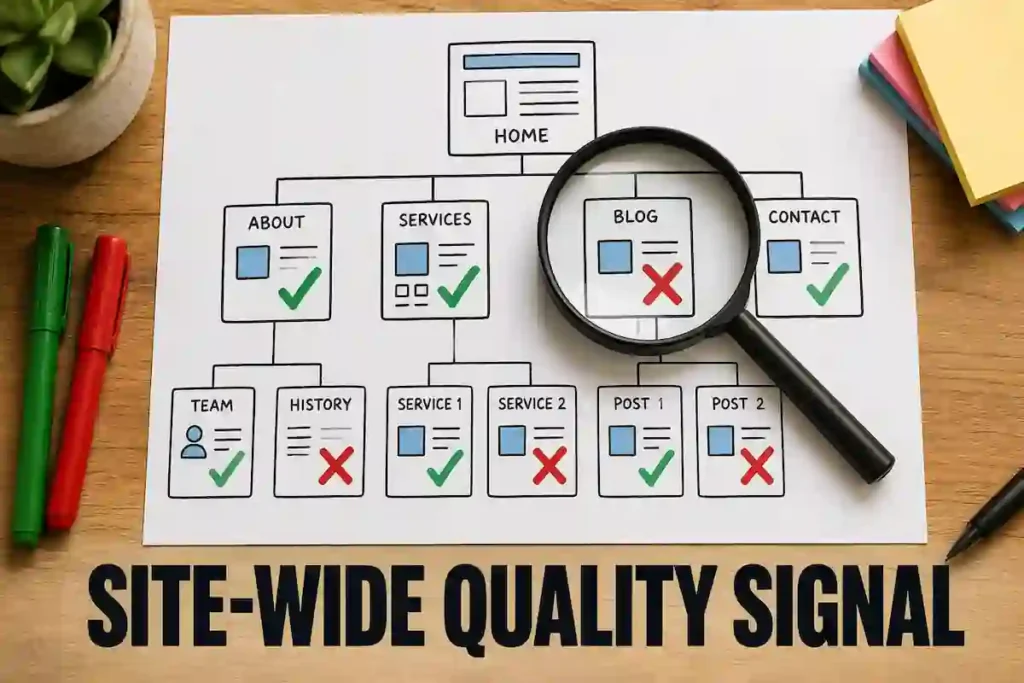
Whenever Google releases a major update, social media is flooded with screenshots of sudden traffic drop-offs. But rankings do not vanish without reason.
One annoying pitfall is having content that was created mostly for search rather than reader benefit.
Think of it as an example of someone searching for: “best budget laptop for students”. They arrive at an article that’s 700 words long before ever saying ‘Here are the recommendations’.
Most people just go back.
Compare it now with an article that compares the real models right away, shows how the battery life is, points out the differences that involved the choice, and gives the right solution based on how much the customer wants to spend.
Which of the pages truly merits this ranking?
But that’s the sort of distinction that Google’s algorithms are starting to pick up on. Some telltales are sites that publish 200+ AI-assisted articles with no new ideas.
Yes, AI can make the writing process faster, but it doesn’t inherently produce useful output.
If all the articles read the same, have no working examples, and are just paraphrases of existing pages, then there is very little incentive for Google to rank that highly.
Many of the publication procedures I have observed to date continue to be preoccupied with the precise length.
A 3,000-word article is not necessarily better than a 1,400-word article. If half of those words just make the same point multiple times, you begin to notice.
And it would appear that search engines are beginning to notice. The websites whose ranks survived the rollout generally appeared to have a similarity. They gave a clear answer to the questions.
And they remained concentrated. And they had respect for the reader’s time.
Besides that, our profound discussion about how you can recover from a Google core update shows the diagnostic stages in much greater depth than what we can tackle here, in case you have experienced a ranking drop and are wondering if it may be the result of this change.
SEO Strategy Is Changing: Here’s What That Really Means
For several years, numerous SEO checklists all appeared practically identical. Include the keyword in the heading. For headings, use it.
A certain number of words need to be written.
Whatever the source of traffic now arriving in your website, you will want to convert as much of it as you possibly can into a targeted list of delighted, monetized buyers and responders.
The most cost-effective way of doing that is via building backlinks. Repeat. Those essentials still count, but not so much.
Most of the seo strategy today is planning at a much earlier stage-with the initial search: why, what for? Imagine someone searches: How the 2026 Helpful Content Update affects small business websites. They’re probably concerned.
Perhaps their traffic has suffered a decline. Or perhaps they’re just trying to attract more users. Perhaps they’re trying to find out if AI-created articles are still publishing-worthy.
If all your article does is define the update, you’ve completely missed the point. An informative article details what is happening, reasons for the alteration in rankings, mistakes to avoid, and what can be done now.
Always leaving the reader wanting more. That’s what makes it interesting. And the same seems to be more often than not the case, in particular with every major update. Search Engine Optimization did not die.
It’s just getting more human. The sites that know their customers before going after keywords could find surviving these updates a lot easier for them than most.
How to Adapt Your Content Strategy After the Update
Watching rankings go up and down might tempt you to shoot it up so that every page gets rewritten overnight. I have seen website owners ruthlessly delete dozens of articles in a frenzy, only to discover that it wasn’t the quantity of posts that mattered. It was the result and motivation.
A smarter strategy is to go easy on your publishing, and correct the problems in your content fairly and consistently. Open up one of your articles, and ask this one simple question: If I were looking for this information, would I save this page into my favorites?
If the answer is “likely no, ” then you’ve stumbled onto a winner. Begin with the pages that still receive regular volume.
These pages already have the eyes of Google, so simply grow them with newer content, stronger illustrations, more current screenshots, or a more lucid explanation rather than publishing five new posts to target the same terms. One other good habit to develop is writing based on the reader’s journey rather than a keyword list.
If someone googles “how to recover after the 2026 Helpful Content Update,” they aren’t coming for a history lesson about Google’s algorithms. They’re anxious. They’re losing traffic, and they need action they can take right now.
This is the point at which no more original insight can be provided. Providing the reasons why specific pages did not rank, providing a tangible example of when they did, and highlighting errors you’ve found across sites in the niche makes your article much more useful than just copying the traditional headlines.
And don’t ignore the content from the previous year. Revamping an article put out a year ago with new information, improved images, and stronger details can have a more significant impact than putting out three hastily written articles within the span of a week.
What Still Works in SEO in 2026
Many think that every Google update alters the rules dramatically.
It doesn’t. The core is still the same. What has changed, though, is that the core is no longer to be regarded as core but to be anticipated. Good keyword research is still crucial, as people need to find your content in the first place.
Clear page titles are still helpful for readers and search engines alike, understanding what a page is about. Internal linking still helps visitors navigate to related content naturally.
But none of what I just said will save the article that doesn’t solve the reader’s question. I’ve observed a trend that I think successful websites are adopting.
They are producing less content, but focusing on making each piece extremely well. Rather than going after every hot trend and keyword, they are investing their time in creating guides and tools that are still valuable months or years from now.
For instance, a comprehensive tutorial on how a local Karachi-based business can improve its search engine presence is probably more valuable over time than ten short blog posts mentioning a few SEO news items that quickly become obsolete. Another trend is transparency.
When you’re discussing something that can’t be glossed over or “pygmalionsed, ” disclose that -say there’s no magic wand, no arbitrating algorithm or database of Worldclocks. Trust will keep adding to your stable, and publishing honestly on flaws loses you trust.
In many ways, SEO in 2026 is less about playing the algorithm and more about gaining someone’s attention.
To get to the source, rather than reading someone’s interpretation of it, Google’s own advice on generating helpful, reliable, and people-first content is, yes, a worthwhile read – this document is the one on which every strategy mentioned above is based, and it’s also frequently updated as Google’s thought processes change.
Common Mistakes Website Owners Are Still Making
There is a common mistake, regardless of niche: putting content out there before asking, Should this even be here? You could have hundreds of articles on your website that all attempt to find the same answer in the same fashion.
Yet, no matter how similar they are, one more is probably not going to make a difference to your website. There’s another risk. Overreliance on AI without human reinforcements.
Sometimes AI makes initial drafts more efficient, helps in structuring an argument, or enhances editing procedures. That’s fine.
But the end reader can discern when an article doesn’t have ‘any real-world examples, any practical application, or a specific perspective. And then there’s a strange preoccupation with a limit on word count.
While some publishers think every article must be over 3,000 words because search engines favor longer copy, that isn’t necessarily true, as long as every part actually adds something.
If they have to scroll past the same advice a dozen times before they find the specific answer they’re looking for, it’s friction rather than helpfulness.
Overlooking the importance of search intent is the second most costly mistake one can make. Looking for “best SEO audit tools” means you are given what is better than others. The price, the good, the bad, the best of them…not a long article explaining what is SEO. Lastly, there are numerous websites that ignore the user experience entirely.
Slow-loading pages, annoying advertisements and pop-ups, bad formatting for mobile phones, and complicated navigation are all very discouraging for new users to visit.
This update is not just about producing high-quality articles. It’s about making a better experience the moment a person lands on your web page.
A Practical Recovery Checklist
What if your traffic decreased after the update? Don’t think your website is done at that point. A recovery is like a recovery. It’s a process.
Begin by going through your most significant pages one by one. You can identify obsolete data, repetition of paragraphs, a poor opening paragraph, and which questions are not asked till the end.
Then, analyze your article against the existing top pages. Do not copy their content. Spot what they have added to your content.
They might have some real sample images, comparison tables, fresh data, or a clearer etymology. Continue to internal link more strongly.
Once the target market is finished reading one article, you don’t want to leave them in a dead end. Guide them intuitively toward related topics to their next question. It’s also useful to see if you have published lots of articles around very similar keywords.
If those pages are competing with each other, it will be better to pool them together into one more powerful page rather than keeping them as weaker duplicates. And lastly, giving up is not an option.
Google updates often don’t get reversed in a few days. Sometimes it takes several weeks or even months for an update to be reflected in the rankings.
Just continue to add real value to your site and avoid chasing down every rumor propagated on social media. Regularity generally trumps panic.
Final Thoughts
There are always winners and losers with every big Google update, but the important thing to learn is surprisingly straightforward.
The sites that persistently deliver value to genuine users generally survive the shakeups far more easily than those who chase outlines.
The 2026 Helpful Content Update is not telling publishers to turn away from SEO.
Instead, it’s telling them to look at SEO as a tool to help deliver helpful content to the audience that is looking for it. How do you decide on the next article you should publish?
Instead of asking yourself, “How can I optimize for this keyword?” No!
Ask instead, “If you were to come to this page wanting to find exactly what you needed, what might have persuaded you to close it?”
That little change of perspective can alter your content creation process, and gradually, it can also influence the algorithms’ recognition of said content.
Frequently Asked Questions
Is the 2026 Helpful Content Update only concerned with AI issues?
No. AI’s not the target.
Shoddily written content is. Even an AI-generated article that is edited well, fact-checked, and added depth with original information will rank. Oops.
How long does it take to recover after a helpful content update?
No hard timeframe.
Some sites realize their results a few days after refreshing the main pages, whereas other sites might take several months of consistent refresh to see progress in rankings.
Should I delete articles that aren’t performing?
Not right away. Several underperforming essays can be improved easily. Often that can be done through restructuring, adding information, improving examples, and clarifying the answer.
Content should only be removed if it contributes little and can’t be made more meaningful easily.
Should we forget about keyword research? Is it still useful?
Definitely. Keywords give you an idea of what people are googling. The difference being: That is now where your work begins, not where it ends. For once, your webpage must also be a page after they arrive.
What’s the biggest lesson from this update?
Write for people first. If your article truly answers questions better than other pages, you’re creating something that can withstand many future algorithm changes.