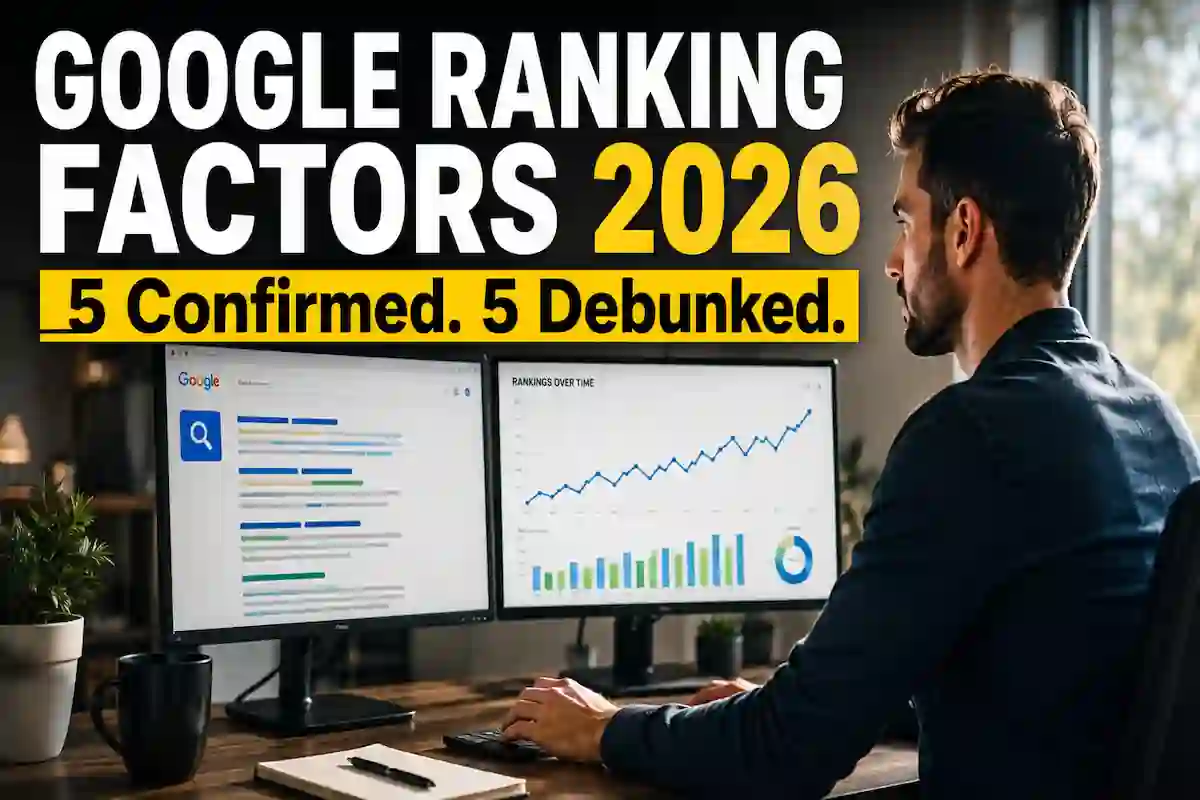
5 Ranking Factors Google Confirmed (And 5 It Debunked) This Year
Google ranking factors 2026 became a little clearer this year, and, at the same time, more confusing. Here’s what went on. There were the DOJ antitrust hearings, which forced Google to open up click tracking systems like NavBoost. Plus there was the Content Warehouse API leak incident, which has still been the subject of ongoing SEO Twitter debates.
Then there were Google’s gentle Search Central updates, which, in effect, revealed quite a bit about this ranking factor issue. We received more official confirmations of Google changes this year than in the previous five altogether. But on the flip side, the whole ‘factor’ part of the ranking ‘factor’ advice that half of us have been passing around in client onboarding documents has already been categorically stated and then repeated by Google as of no consequence. (Not that one should necessarily trust Google at this stage of the game, though). I mainly go through Search Console data for clients in my spare time, but also have the time to keep watching the growth in both lists.
Let’s check out the five ranking factors that Google revealed this year, followed by five ranking factors that, due to being debunked, need to stay forever in the ‘fact’ land.
What Google Actually Confirmed
Click and engagement signals via NavBoost are real
This is probably the largest and most important thing. Google using click-through data as a ranking factor was just an idea that most SEOs dismissed as being a wild guess. Then a Google VP, Pandu Nayak, under oath, during a DOJ case he was involved in, talked about something they called NavBoost, which was the kind of system that did precisely that.
NavBoost counts a few types of clicks: “good clicks”, where you end up on a page and you keep reading; “bad clicks”, when a page only opens your mind up for a moment and you click your way back to results; and then “last longest click”, which is the moment the search is basically stopped and there is no new result being opened or clicked on.
They have also taken into account all of the browser data available in Chrome on the Internet a lot, which means it’s not just the search results page the clicks were coming from, but many more locations and devices that are now being considered. That means your title tag and meta description have now stopped being a mere SEO tactic – they actually determine the quality of clicks the users make on your site, and this way have become something important in your SEO plan. I myself have noticed quite an elevation in the rankings of one of my clients after we rephrased the page titles to a more relevant version without even bringing in the new content!
Core Web Vitals, with INP now in the mix
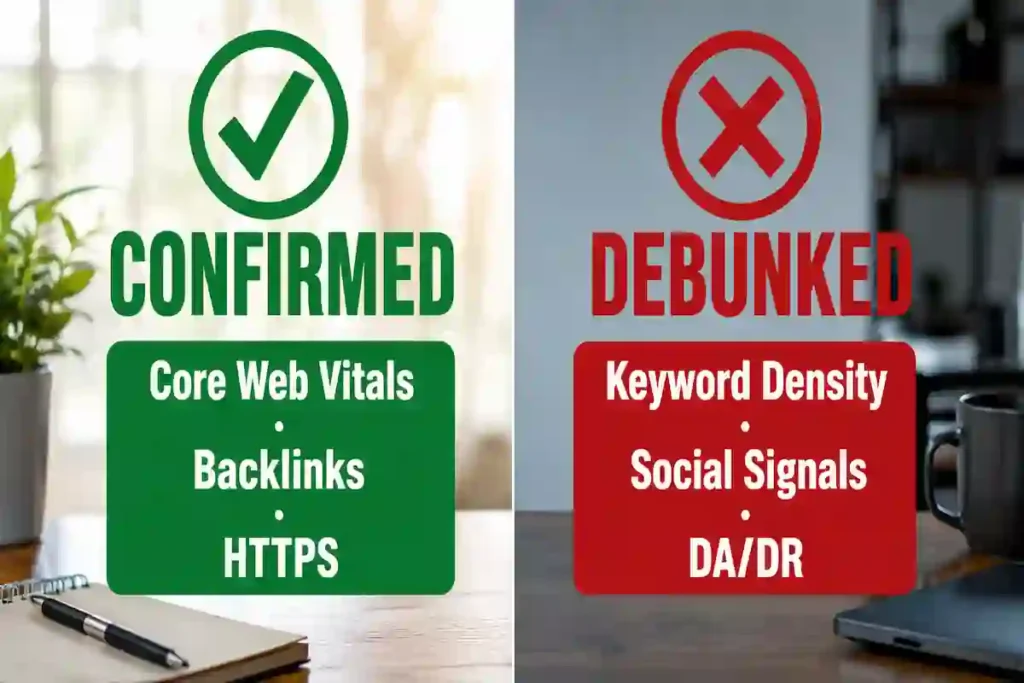
Google has definitely stated it, and 2026 was just confirmation – they have only altered the ways the metrics are measured. INP (Interaction to Next Paint) has taken the place of FID as the responsiveness metric, together with LCP (loading speed) and CLS (visual stability); they stand as the three major measures Google uses based on the actual Chrome user data and not lab tests.
Numbers to reach while a site audit: LCP less than 2.5 sec, INP less than 200 ms, CLS less than 0.1. Sites that passed even the most thorough of SEO checklists were still reported using Core Web Vitals since the users didn’t make real-world tests on a mid-range Android phone with 4G – that’s just by the way what the rest of the world uses.
If you prefer the numbers directly sourced rather than seeing them filtered through a blog post, Google has its Core Web Vitals documentation page where exact thresholds are revealed, and they clarify the connection between metrics and page experience – it is something worth marking since Google updates the page directly instead of using blog announcements as the means.
HTTPS is a confirmed baseline signal
Older others will probably roll their eyes while younger readers gasp with the excitement of knowing something so big yet nobody cares anymore. Though it’s always worth reminding those who aren’t familiar with the latest changes or those who are still not sure about something that has been confirmed years ago. For example, you can count on HTTPS these days to be one of the main requirements. It is no longer something that will make you stick out, as others also have it, which means it is now just like having a phone that will be used during the pandemic.
If you decide today to convert your website, which is currently on HTTP, to one using HTTPS, then you might expect it to be an act of giving you a promotion, which in most cases just won’t happen. On another note, not having it will result in you never achieving high rankings on Google; that is why if you don’t have HTTPS, then there is definitely something else that might be going wrong.
Backlinks and site-wide authority, but reweighted
Backlinks remain one of the main signals that Google considers in its algorithm. And that hasn’t been changed. What is new is the bluntness with which Google uses these signals – this Content Warehouse leak showed one site’s Authority score among other things confirming once again that Google does site-wide link evaluation rather than judging individual pages entirely on link profile of that specific page.
We witnessed exactly this kind of shift toward relevance being more important than sheer volume when there was a big spike in volatility recently too. After a harsh algorithm update, we helped a client recover their website. The websites that first fully recovered were not necessarily those having the most links, but the ones where the links were most closely related to the topics being discussed. We have fully explained our recovery process after the change in the Google Core Updates Recovery study; if you are also currently seeing a downturn, just like us.
What will be the impact on practitioners – it should now mean that one link from a truly relevant, topic-aligned website will outperform many hundreds of similar links coming Mostly from low quality guest blogs or other so-called directories. Two years ago, I personally decided to discontinue chasing link count for my company’s clientele, and started focusing on link relevance. This has much improved recovery times of ranking losses due to site-wide SEO penalties with each successive case.
Helpful content and E-E-A-T as a trust layer
Google’s Helpful Content update has now become a permanent part of the core ranking algorithm instead of being just a separate and occasionally launched update. E-E-A-T (experience, expertise, authoritativeness, and trust) is not just one more factor to consider but rather the main filter through which Google filters out content.
For YMYL topics (money, medical, legal), the requirement for the author’s bio, a visible credential, or an obvious sign of personal experience is more or less the case. Content produced by AI, which doesn’t contain any of these, gets discarded even before it has a chance to compete on content quality alone.
What Google Debunked (Or Just Never Confirmed)
The 2- 3% keyword density rule was never an official ranking factor of Google. Google staff repeated this clearly again multiple times this year. Google’s technology is so advanced now that it can decipher meaning and detect synonyms and topics, so cramming your topic keyword into every next sentence will no longer be a great idea. Instead of being interpreted as relevant, this will be seen as an attempt to ‘keyword stuff’, and that would be considered of poor quality rather than a helpful change.
Keyword density
This year, Google once more confirmed that meta descriptions do not directly influence rankings. But they are important, just in a less obvious way – a compelling meta description attracts more clicks, and from point #1 above, click behavior does influence ranking systems. Because of this, make use of good ones. But don’t imagine that Google is scanning them for a relevance signal on their own.
Meta descriptions as a direct ranking signal
Domain authority (DA) and domain rating (DR), while popular marketing and client pitch metrics, come exclusively from third-party tools such as Moz and Ahrefs. Google doesn’t use either measure. They are helpful if you want to quickly compare websites, but they are not official ranking factors. In fact, Google has explicitly stated this fact in their guidelines.
Domain Authority and Domain Rating
Google has repeatedly confirmed, most recently in February, that it doesn’t consider social shares as links, nor do they treat the quantity of likes as ranking signals. Social media may still be useful to us in an indirect way – by having higher visibility, you can expect people to share your links or mention your brand – yet there is no straight line of cause and effect from doing a social media hit to ranking better.
Social signals — likes, shares, follower counts.
This one is, yes, a new refutation from around 2026. The Google official deprecation of FAQ rich results in their SERPs in May, it essentially means that no site, even the one with the perfect schema markup, can still display the little expandable accordion snippets at the top of the SERPs. The surprise Though lies in Google’s own statement that they are still using FAQPage schema to better understand page content, and also other AI crawlers (Bing, Perplexity, etc.) are processing schema of the site for their own results. So, don’t remove the FAQ rich results page – stop just expecting it will take the SERP position for you like before.
The Pattern, If You’re Looking For One
Every single one of the established factors this year relates to something tangible for the user: was the page loading quickly enough, did the click lead the user to the right place, is the link actually useful to the user, is the content genuinely informative Then again, all disavowed myths go back to the invention and subsequent fixation of a tool vendor or a rather old SEO forum post.
Until it is shown otherwise, any ranking factor that is not able to trace back to either a real statement by Google or a name of a leaking internal system should be regarded as folklore. This one filtering criterion alone will cut down your working minutes more effectively than checking off your tasks.
None of this is new in and of itself, still. Core Web Vitals, backlinks, and E-E-A-T all sit above the same baseline: a site that is structured, crawlable, and geared towards actual topical depth, rather than one-off blog posts. If you’re after the broader view on how this all interconnects, our Six Pillars of SEO structure shows you precisely how we order technical, content and authority work representing clients so nothing here gets individually chased.
The Pattern, If You’re Looking For One
Does Google openly announce the factors that influence rankings regularly?
Not in a set schedule, definitely not. The official sources for confirming changes usually are blog entries, updates of Search Central Docs, and presentations at events. Besides, this year’s unique case involved legal testimonies that were not at all intended for the SEO community.
With the disappearance of the rich results, is it a good idea to eliminate FAQ schema from your website?
In fact, you need not do so. The fact remains that Google can make use of it, and AI-based question and answer systems do as well – for their cited results. That means, by eliminating the schema, you merely forego an advantage and get nothing in return.
Would you suggest the cessation of backlink building in response to the algorithmic reweighting of this factor?
On the contrary, backlinking continues to be one of the most significant factors that Google can be counted upon for. The change is about valuing fewer high-quality backlinks rather than having a larger quantity of not-so-strong ones.